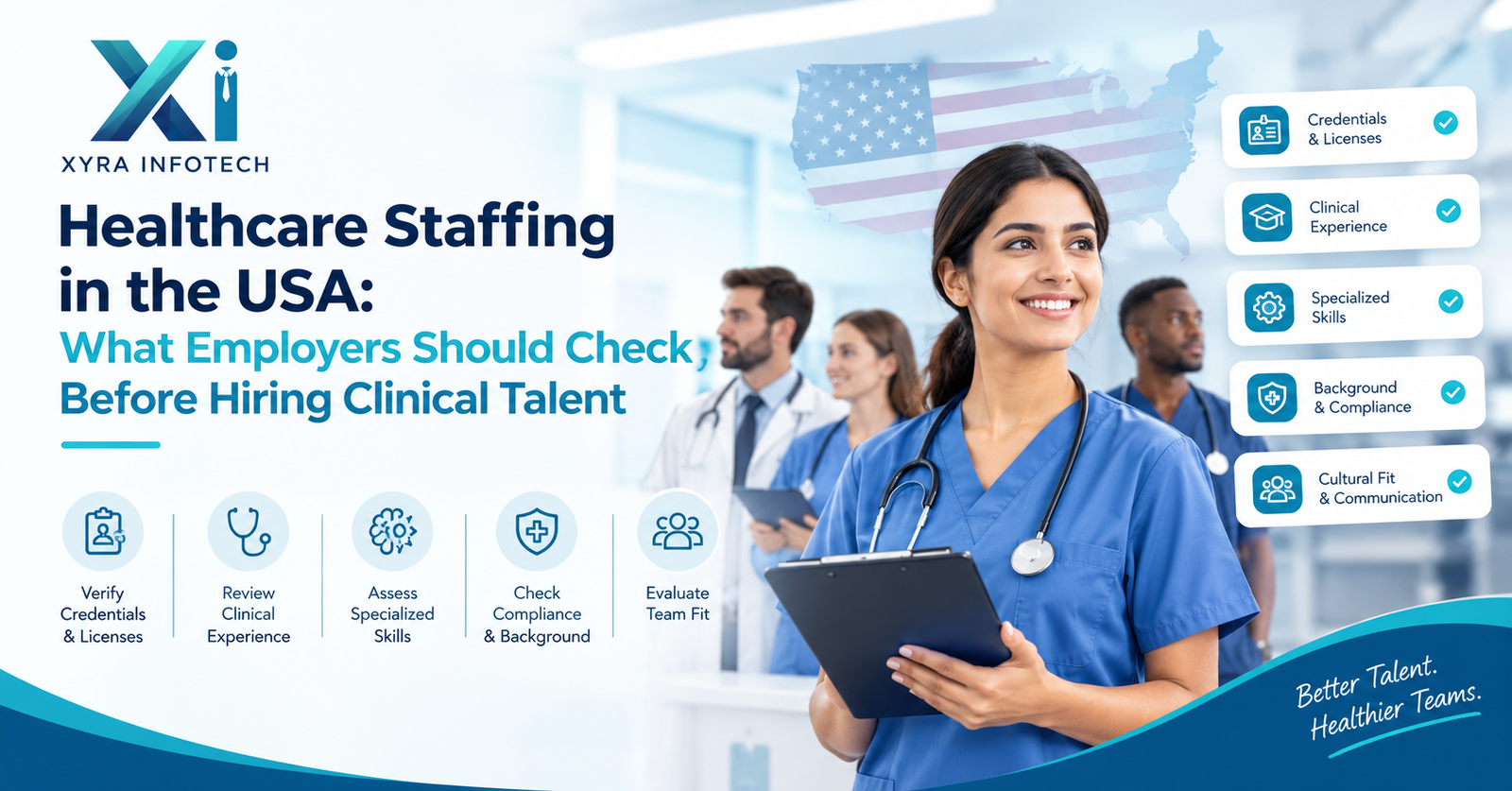
Few healthcare employers have the time to hire someone on a spur of the moment basis. This includes nurse, allied health, laboratory, or clinical support position that is not filled, which may impact patient care, scheduling, employee well-being and compliance. If they decide to work with a staffing partner, they require a staffing partner with more than a quick résumé. They require assurance that all professionals are competent, fit and qualified in the assignment.
This is why it’s essential to examine credentials, competence, experience, safety and communication when hiring healthcare staff. Employers should think about these factors before selecting a staffing or clinical personnel service or hiring employees to care for patients.
Verify Every Credential
A clinical professional’s license and certification must be current, fit for the role and verified from a primary source. The Joint Commission suggests verifying credentials that are relevant to the job at time of hire or rehire, such as state registration and credentials such as education and training.
Rely on only a résumé or photocopy that candidate provides. Check the credential with the appropriate state licensing board, credentialing organization, or primary source. Ensure the person has the correct license, the license is current, the correct specialty, restrictions, disciplinary record and it will allow the person to actually do the work that is asked of them.
This is important since it can differ by profession and state. A nurse, therapist, technician, advanced practice provider or physician may be subject to different licensing and scope-of-practice regulations.
Match Skills with Assignment
Just because a person has a license doesn’t guarantee that they’re prepared to work in all clinical conditions. Employers should match the experience and competency of each candidate to the job in hand.
Take into account the patient population, the acuity level, the type of unit, the equipment, the electronic health record (EHR), the clinical procedures and workload of the unit. Work in an ED may require further training and preparation for someone who has experience working in outpatient care. Someone who has experience working with adults may not be prepared to care for a neonatal or pediatric patient.
Work with staffing partners to find out how competency is assessed. Skills checklists, clinical references, structured interviews, knowledge assessments, simulation or orientation to the facility may be used as part of the process. The Joint Commission has a competency, background check, health status and assignment-qualifications based certificate program for healthcare staffing.
Check Work References
It is important to assess clinical experience, not take it for granted. Review previous employers, dates of service, job responsibilities, specialties, shift experience, and reason for departure (highly recommended) legally.
Reliability, communication, teamwork, professionalism and clinical judgment can be gleaned from references. Put the focus question for the assignment rather than taking for granted statements about performance.
The employer should also ascertain whether the candidate has past experience of the documentation systems the facility will follow, the standard of patient care the facility will uphold and the expectations of teamwork the facility will have. This information may impact the rate of productivity for a new employee.
Complete Background Screening
Background screening should adhere to federal, state and local laws and the healthcare organization’s background screening needs. This can involve a criminal-history search, an employment check, reference checks, drug screening, exclusion checks and an identity check, depending on the position.
All screening procedures must be consistent and job-related. Employers need to know the people who order the checks, how the results are reviewed, what happens to adverse information and if rechecks are performed throughout the assignment.
The staffing firm should be able to detail their process and be able to provide documentation if asked to. The standards for healthcare staffing highlight the importance of doing thorough checks to ensure staff are fit and qualified to do their job safely and legally.
Check Health and Safety Conditions
Screening, fit testing, physical exams and immunizations for flu or other documentation for clinical workplaces may be required. Requirements are based on facility, position, patient population and law.
Employers will need to be aware of these requirements prior to the worker’s start date. There can be delays if a candidate is qualified, but fails to submit a health document on time on or by the due date or cannot complete a required screening by that date.
Safety orientation is also a critical factor. All temporary and contract workers need to be aware of infection control, PPE, emergency procedures, incident reporting, workplace violence prevention and patient privacy expectations.
Understand Compliance Responsibilities
Prior to entering into an agreement, make sure to understand how payroll, taxes, workers’ comp, unemployment, credential tracking, health documentation, scheduling, training, incident reporting and performance management will be dealt with.
There couldn’t be shared responsibility if the responsibilities were not shared. Provide written authorisations, response time, documentation needs and escalation procedures.
Check if the staffing partner is familiar with the state licensing laws and healthcare regulations. If the company employs employees in more than one state, ensure that the company has a system in place for monitoring renewals, compact licenses, evolving requirements and facility-specific credentials.
Assess the effectiveness of Staffing Partner
There are lots of recruitment companies in USA, but healthcare employers need to keep in mind the experience of the companies concerned and not size only. Inquire about the number of clinical placements the agency can make, the specialties they specialize in, what they do in an emergency and whether their recruiters have experience in the healthcare industry.
The best staffing agencies in USA like Xyra Infotech should be able to give you references and tell you about their screening process and what they can report you back about in measurement terms such as fill rates, retention, attendance, and quality of candidates. While the broad reach that the biggest staffing companies in USA might provide is OK, a broader partner might have more in-depth knowledge of a specific clinical market.
Employers should also inquire about a firm’s ability to have a talent pool ready to go, temporary and permanent placements and a work around if a placement is not successful.
Prioritize Communication
Effective communication helps to keep issues small and stop them from turning into patient problems. Appoint one main contact, set response times, set up escalation processes, develop a reporting method for absence, performance, changes to credentials, safety issues and more.
Staffing partner must be candid in terms of availability, salary expectations, interview process and dates. Promises made in haste, more than is warranted, may turn out to be bigger issues in the future.
We believe at Xyra Infotech, that staffing in healthcare should be fast yet responsible. Employers demand clinical personnel that can work safely, rapidly and be a positive influence on patient care.
Make sure you check credential, test competency, research experience, screening, define roles and responsibilities and select a partner that is aware of the stakes. A staffing relationship is not merely about filling up a staffing. It guards the patient, assists the care team and enhances the organization.
Frequently Asked Questions (FAQs)
What would be the red flags for employers to check before hiring clinical talent?
Employers should check all applicants’ licenses, certifications, registrations, education, work experience, references, clinical training and status to ensure that they are qualified to carry out the tasks assigned to them. Wherever possible credentials must be verified from the relevant principal source.
Why is competency assessment relevant in the healthcare staffing process?
With a valid license, it’s not enough to ensure that a professional is ready for all clinical settings. Employers should evaluate the experience the candidate has had with that patient population, equipment, procedure, electronic health records, documentation requirements and the intensity of patient care needed for the job.
What are some of the background checks that are generally mandatory for clinical workers?
The type of screening chosen may involve criminal history checks, employment verification, reference checks, exclusion-list checks, drug testing and checks on identity. Consistently implement screening procedures that comply with applicable laws.
How to ensure the reliability of a staffing agency for health care?
Employers will want to know what specialty areas the agency has, how they validate their credentials, what screenings they employ, how quickly they respond, how long they keep candidates, how they replace candidates and what feedback the agency has from their clients. Another thing to be determined is how the payroll, workers’ compensation, compliance, health documentation and incident reporting will be handled.
In what ways can Xyra Infotech assist in the healthcare staffing requirement?
Whether it’s for sourcing and credential verification, screening, placement or communicating with candidates, Xyra Infotech can enable your company to reach the right clinical professionals. It’s staffing philosophy is about demonstrating to the professional how well they will complement the facility’s clinical needs.