Often retail companies or finance companies have vastly different employee requirements. Additional staffing might be required during peak seasons, promotions and along with store openings in Retail. There are times throughout the year when finance teams might require extra help, such as during audits or tax season, month-end close and system upgrade.
The decision of temporary or permanent staffing is not always an easy one to make. The decision of which one to choose rests on the demands of the workload, the budget, and skill level and waning of the business, as well as the required support length. With the best support from top staffing agencies in USA, it is easier for businesses to select a hiring model that works in their favor and benefits them.
Understand Both Hiring Models
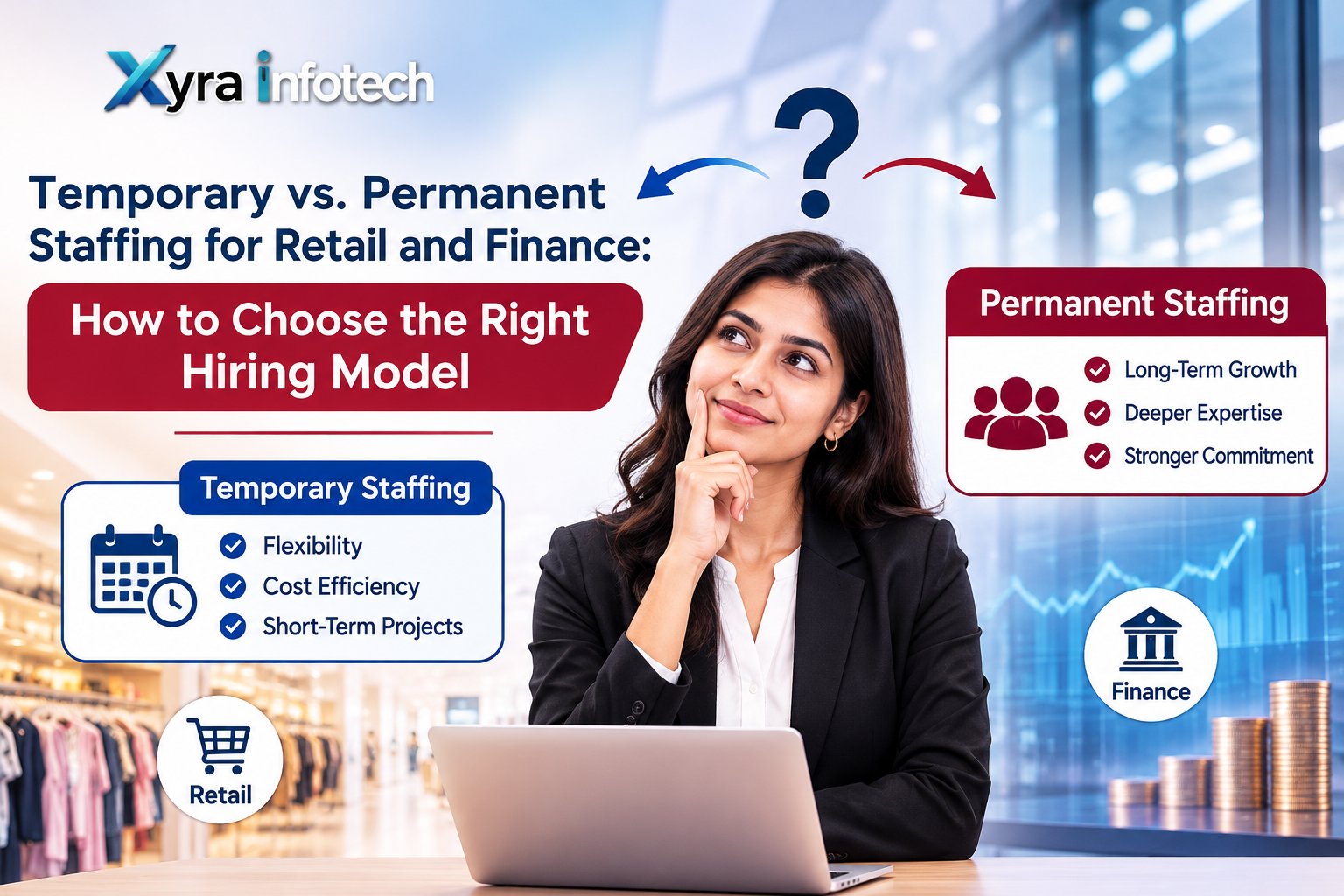
Employers have access to professionals for a certain period by working with temporary staffing. These workers are usually hired to meet the seasonal need, to replace those workers who are unable to work or are unavailable to the company, to help with special projects or to help during the busy peak periods. Temporary staffing is typically employed for temporary, seasonal, project or “Oops” staffing requirements that are only temporary.
Permanent staffing, on the other hand, aims to have staff provided for positions that are continual in nature and crucial to the business. Permanent staff gain institutional knowledge, prime a team for long-term success and promote stability.
| Factor | Temporary staffing | Permanent staffing |
|---|---|---|
| Best use | Seasonal demand, projects and coverage | Core roles and long-term needs |
| Hiring speed | Usually faster | May take longer |
| Flexibility | High | Lower |
| Cost commitment | Short-term | Ongoing salary and benefits |
| Knowledge retention | Limited | Strong |
| Best for | Retail peaks and finance projects | Leadership and recurring responsibilities |
When Temporary Staffing Makes Sense
When there is other short time reduction in the work or when the business requirement is not certain or time sensitive, it is all the more advisable choice to opt for the temporary staffing option. During busy shopping seasons, retailers might require extra employees, whether in the company’s stores, cashier lines or warehouse. You might be hired as an accountant, auditor, payroll specialist or financial analyst by the finance employer for a specific project.
This can benefit the employees and employer’s organization in a number of ways:
- Speed up staffing easily, based on season demand.
- Responsibilities for knock-on vacation or leave or absenteeism.
- Provide support for the audit and tax filing or month-end close process.
- Interact with a specific project with special skills.
- Conduct a test run prior to giving an offer.
- Manage labor during uncertain times.
Temporary staffing helps give the employer some flexibility in response to varying workloads, rather than hiring the wrong person that they end up regretting later.
According to Robert Half, hiring temporary staff can also be an effective way to make a business ready for the need to fill short-term or special requirements, such as a seasonal staffing requirement, a specific project’s demands or an urgent hiring requirement, and can be leveraged to test candidates before making a permanent offer.
When Permanent Staffing makes Sense
If a position is vital to the ongoing business and operations, a permanent job is typically the preferred option. It’s someone who is involved in the retail side, such as a store manager, buyer, customer-experience professionals who are senior. It can include controllers, finance managers, senior accountants and financial planning professionals in finance.
Permanent employees are useful when employers require:
- Effective leadership and responsibility.
- Thorough understanding of company systems or processes.
- Relationships with customers over the long-term.
- Compliant and supportive in stable format.
- Support for career progression and promotion.
- Good, competent core team.
Sixty-six percent of company leaders state they will hire more permanent staff for the second-half of 2026, according to Robert Half. This indicates that there is still some importance amongst employers to maintaining capability over the long-term by hiring a permanent employee.
Retail Needs Flexibility
Orders for retail goods are subject to rapid fluctuations. Need more employees at periods of time when there are holidays, sales events or when a store is opening, fewer employees when demand returns to normal.
Having temporary employees lowers retail employers’ permanent payroll effects on helping to handle these shifts. Also, it enables managers to hire staff who are available when they are needed and have the proper customer-service reception.
Yet retailers need to have a solid, enduring customer base too. They are made up of trained staff and experienced employees, who train new staff and by working extra hours, help to ensure service quality when workload is heavier.
Finance Needs Specialized Skills
Working in finance may require technical skills, be attentive to detail and have a knowledge of the rules. A temporary professional is well-suited for an audit, business project such as ERP implementation or tax season. If the position requires a high degree of continuous financial controls, forecasting or leadership, it might be more appropriate to hire a person on a permanent basis.
Organizations should determine if the job is a repeated or a project. With such a long-term need, permanent hiring might be more cost effective. If the requirement is for a few months, temporary staffing is probably more achievable.
Consider a Hybrid Approach
There are some employers out there who don’t have to select only one model: F+S (Flexibility + Stability).
For instance a finance team could have permanent accountants in place to report monthly and have contract accountants during audits. Leadership in a store may remain the same all year round while during the holiday period additional employees are brought on board for one-off periods.
In this way, business organizations can obtain the knowledge and leadership to sustain the future and can tackle the workload peaks, as well as.
Consider Cost Beyond Salary
While temporary staffing can be more costly onboarding hourly, it can save on benefits, long-term obligations and hiring issues. While the initial recruitment cost for hiring may be higher, hiring a permanent employee can result in better retention and continuity, particularly for critical positions.
Employers should compare:
- Labor costs: payroll and benefits.
- Costs of recruitment and induction.
- Ramping up training and productivity time.
- Impacts on staff-existing personnel overtime or burnout issues.
- Cost of turnover.
- Micro Mentors will be evaluating the value of specialized skills.
The right choice may not be the lowest incremental cost. It will be the one that will meet the needs of business performance best in the future.
Partner with Proper Staffing Agency
Today, the best IT staffing firms in USA can accomplish the company’s need to discover people with the technical expertise it takes to operate up-to-date retail and financial operations. This can include cost of goods managers, data analysts, ecommerce people and finance system professionals.
Employers should consider both the knowledge of the staffing and recruitment firms and the quality of candidates when they are doing the evaluation on the staffing and recruitment companies for the biggest staffing company in USA and the best staffing & recruiting agency in USA. Xyra Infotech offers financial, technical, marketing, legal and administrative staffing, temporary, contract and permanent positions.
Final Thoughts
Staffing is significantly a part of the retail and financial trade. Temporary and permanent staffing both have a crucial role in retail and financial trades. Temporary filling requires delivering flexibility in order to accommodate periods of increased demand or special projects, whereas permanent staffing will create stability for the organization, leadership and long-term capacity.
The most efficient hiring model for organization is dependent on duties, quantity and company objectives. Having a clear workforce plan, matched with the appropriate staffing partner, employers can develop teams that are flexible and ready to grow.
Frequently Asked Questions (FAQs)
What are the differences between temporary staffing and permanent staffing?
Temporary contracts are used to cover staff who are required for a particular time period, project or season. Permanent staffing supplies permanent positions that are necessary for long run organization development and everyday operations.
When is it the right time to hire temporary staffs for retail businesses?
Retail stores should hire temporary staff at seasonal periods, sales events, if a worker is on vacation or leaves suddenly, inventory times or when they are opening a new store. It assists companies to put on employees early without or simply having to hire them.
When is it beneficial for the finance companies to take permanent staff?
Recurring duties like financial reporting, budgeting, forecasting, compliance, leadership and month-end closing should be performed by permanent staffing or manpower in finance companies. Permanent employees develop a greater understanding of business systems and procedures.
Temporary staffing vs. permanent hiring – which is more budget-friendly?
Hire temporary staff when you need them, as you won’t be committed to expensive salary and benefits packages, potentially making it more economical. In some cases, a permanent hire could make more sense if the position is particularly important and necessitates a continuous career path and expertise that is important.
Is a business allowed to employ both temporary and permanent personnel?
Yes, a hybrid model is employed particularly by retailers and finance companies. For the more permanent jobs, they have permanent staff and for the busier times, audits, system updates or special projects, they hire temporary personnel into the jobs.
What makes Xyra Infotech the best option for employers selecting staffing models?
Xyra Infotech is a firm which helps employers to evaluate their workforce requirements and supply them with temporary staff, contract or permanent employees in areas like finance, technology, retails, marketing, legal and administrative staff roles. The key is to find the right fit to help businesses achieve a balance between flexibility, cost management and recruiting long-term workforce solutions.